
Buying a home in Bluffton, Hilton Head Island, Beaufort, Hardeeville, Ridgeland or elsewhere in the South Carolina Lowcountry comes with an expense buyers sometimes underestimate:
Homeowners insurance.
And here along the coast, shopping for insurance can be considerably more complicated than simply asking, "How much is the annual premium?"
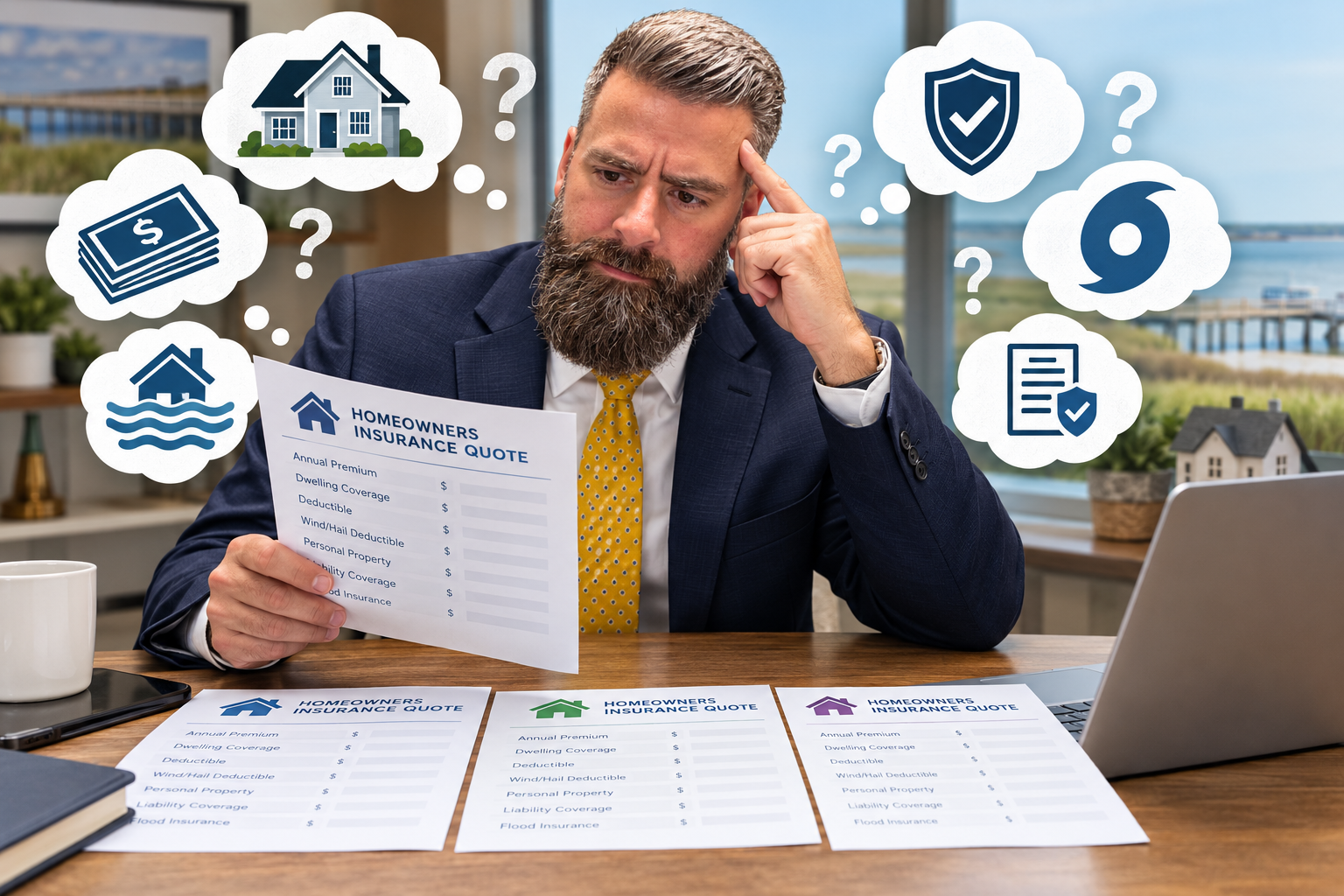
One company might quote $2,800 per year while another quotes $4,000.
At first glance, the $2,800 policy looks like the obvious winner.
But what if:
The first company insures the house for $500,000 while the second estimates $650,000 to rebuild it?
One has a $2,500 deductible while another has a 2% wind/hail or named-storm deductible?
One provides replacement-cost coverage while another uses actual cash value for certain losses?
One includes wind and hail while another requires separate coverage?
One has substantially better water-backup coverage?
One insurance company has stronger financial ratings than the other?
One is an admitted South Carolina insurer while another is a surplus-lines carrier?
One quote includes discounts the other company hasn't considered?
Suddenly, comparing $2,800 to $4,000 isn't really comparing the same product.
When shopping for homeowners insurance, compare the coverage and the company first — then compare the premium.
Start Shopping for Insurance Early
If you're buying a home with a mortgage, your lender will generally require homeowners insurance before closing.
Don't wait until a few days before closing to start shopping.
The South Carolina Department of Insurance specifically encourages consumers to shop around and obtain quotes from multiple companies while comparing coverage, customer service and quality along with price.
I recommend starting the insurance conversation during your due-diligence period.
Insurance costs can vary considerably from one property to another based on factors such as:
Location
Age of the home
Age and condition of the roof
Construction type
Amount of insurance coverage
Deductibles
Wind exposure
Previous claims
Fire protection
Hurricane-mitigation features
Available discounts
That means two homes selling for exactly the same price could have very different insurance costs.
Don't Just Ask, "How Much Is the Insurance?"
Instead, ask:
"What exactly am I getting for that price?"
When requesting quotes, try to have each insurance agent quote comparable coverage.
Otherwise, you're comparing apples to oranges.
I would request quotes from at least three different sources, and potentially more for an older home, waterfront property, coastal property or home that is difficult to insure.
Consider getting quotes from:
An independent insurance agent who can shop multiple carriers
One or more direct insurance companies
Companies you already use for automobile or other insurance
Additional carriers specializing in coastal properties
If you're having difficulty obtaining coverage, the South Carolina Department of Insurance also offers an Insurance Locator program designed to help South Carolina consumers connect with agents and companies offering property insurance.
Military Buyers: Don't Automatically Assume USAA Is the Best Deal
We work with plenty of military buyers in the Lowcountry, particularly because of our proximity to MCAS Beaufort and Parris Island.
USAA is understandably one of the first calls many military families make. It's a familiar company and one they may already trust and use for other financial products.
There's absolutely nothing wrong with getting a quote from USAA.
But don't let brand loyalty replace comparison shopping.
I've seen situations where a buyer's preferred or longtime insurance company was substantially more expensive than another option.
That doesn't necessarily mean one company is "overcharging." Insurance companies evaluate risks differently, offer different coverage and discounts, and may have very different appetites for certain properties or geographic areas.
Get the USAA quote.
Then shop it.
The same advice applies if you've been with any insurance company for 10 or 20 years.
Loyalty doesn't necessarily mean you're currently getting the best combination of price and coverage.
What Is a Homeowners Insurance Deductible?
Your deductible is one of the most important numbers on your insurance quote.
Generally, it's the amount you're responsible for before your insurance pays its portion of a covered property loss.
Here's a simplified example:
Covered loss: $20,000
Deductible: $2,500
Insurance portion: Approximately $17,500
But here in the Lowcountry, there's another number you REALLY need to look for.
Your Wind, Hail, Hurricane or Named-Storm Deductible
Some policies can have separate deductibles for certain types of storm losses.
Instead of being a fixed dollar amount, these deductibles may be expressed as a percentage of your dwelling coverage.
And that percentage can represent a lot more money than buyers realize.
Imagine your home is insured for a rebuilding cost of $600,000.
A 2% deductible = $12,000
A 3% deductible = $18,000
A 5% deductible = $30,000
That's very different from a $2,500 deductible.
So when someone tells me:
"I found insurance that's $800 cheaper!"
My next question would be:
"What are the deductibles?"
Saving $800 a year may not look nearly as attractive if you've unknowingly accepted tens of thousands of dollars of additional potential exposure after a hurricane.
Your Home's Rebuild Value Is NOT the Same as Its Market Value
This creates a lot of confusion.
Let's say you're purchasing a home for:
$750,000
Your insurance company might estimate the replacement cost at:
$575,000
Another company might estimate:
$680,000
Neither number necessarily means the house is worth $575,000 or $680,000.
They're estimating something completely different.
Market Value
Market value is what someone is willing to pay for the property.
That price can include:
The land
Location
Neighborhood
View
Amenities
Community desirability
Supply and demand
Waterfront or golf-course positioning
Replacement Cost
Replacement cost is generally an estimate of what it would cost to reconstruct the insured structure using comparable materials and construction.
Your lot isn't going to burn down.
Your location isn't going to blow away during a hurricane.
The structure, however, could need to be rebuilt.
That's what the insurance company is trying to estimate.
Why Do Different Insurance Companies Give Me Different Rebuild Values?
This is another reason you can't compare quotes based only on premium.
Imagine you receive:
Company A
Annual premium: $2,900
Dwelling coverage: $475,000
Company B
Annual premium: $3,500
Dwelling coverage: $625,000
Company C
Annual premium: $3,900
Dwelling coverage: $700,000
Company A appears cheapest.
But it's also insuring the structure for considerably less.
Insurance companies use replacement-cost estimating systems and their own underwriting assumptions to determine what they believe it would cost to reconstruct a home.
That's why I recommend asking:
"How did you determine my dwelling replacement cost?"
You can also provide information about improvements that might not be obvious from public records:
Custom cabinetry
Hardwood flooring
High-end countertops
Extensive trim
Specialty windows
Luxury bathrooms
Custom outdoor living areas
Unique architectural features
The goal isn't necessarily to find the insurance company with the lowest rebuild estimate.
The goal is to have a reasonable amount of coverage to rebuild your home following a major covered loss.
Replacement Cost vs. Actual Cash Value
These terms matter.
Replacement Cost Value — RCV
Replacement-cost coverage generally pays the cost of repairing or replacing damaged property with comparable new property without deducting for depreciation, subject to the terms and limits of the policy.
Actual Cash Value — ACV
Actual cash value generally takes depreciation into consideration.
Here's a simplified example.
Suppose your roof costs $30,000 to replace today but is already many years old.
Replacement-cost coverage may ultimately provide coverage based on replacing that roof with a comparable new roof, subject to your policy.
Actual-cash-value coverage could reduce the settlement because the damaged roof was already partially through its useful life.
Ask specifically how your roof is covered.
Don't assume every part of your house automatically receives full replacement-cost treatment.
What About Extended Replacement Cost?
This is another coverage worth asking about.
Imagine your insurer estimates your home would cost $600,000 to rebuild.
Then a major hurricane hits the Lowcountry.
Thousands of homes suddenly need repairs.
Contractors are overwhelmed.
Labor becomes scarce.
Materials become harder to obtain.
Construction costs increase.
Your original $600,000 estimate might no longer be enough.
Ask whether your policy offers extended replacement-cost coverage or another feature providing additional protection if rebuilding costs exceed your Coverage A dwelling limit.
Have the insurance agent explain exactly how it works because policy terms can vary.
Research the Insurance Company — Not Just the Quote
This is a step buyers sometimes overlook.
You aren't just buying a piece of paper.
You're entering into a contract with a company you're relying on to perform after potentially suffering one of the largest financial losses of your life.
That's particularly important in coastal South Carolina, where insurance companies can have significant hurricane and wind exposure.
Before choosing an insurer, research the actual insurance carrier underwriting the policy.
The South Carolina Department of Insurance provides consumers with tools for researching insurance companies, and the NAIC Consumer Insurance Search allows consumers to investigate licensing, financial information and complaint data.
Check the Carrier's Financial Strength Rating
Insurance companies receive financial-strength ratings designed to evaluate their ability to meet their insurance obligations.
Organizations you may encounter include:
AM Best
Demotech
Standard & Poor's
Moody's
Fitch
Not every insurance company will be rated by every organization.
And ratings from different agencies shouldn't necessarily be compared as though their grading systems are identical.
A financial-strength rating also isn't a guarantee that a company will never experience problems.
But it is an important piece of the puzzle.
Ask your agent:
"What is the financial-strength rating of the actual carrier underwriting this policy, and which rating organization issued it?"
If you've never heard of the insurance company, don't automatically dismiss it.
There are regional and specialty insurers that many homeowners may not recognize.
But that makes researching the company even more important.
Check the Insurance Company's Complaint History
Financial strength tells you one thing.
Claims and complaint history can tell you something else.
The South Carolina Department of Insurance tracks consumer complaints involving insurance companies and publishes complaint summaries. Those reports include complaints received, confirmed complaints and premium information for insurers doing business in the state.
The NAIC also provides a Consumer Insurance Search where consumers can research complaints, licensing and financial information. It specifically advises consumers not to make a decision based on one factor alone, but instead to consider complaints, financial information and business volume together.
That's important.
Don't see five complaints against Company A and one complaint against Company B and automatically assume Company B is better.
Company A might insure hundreds of thousands more homes.
Look for context and patterns.
Read Reviews — But Put Them in Perspective
Online reviews can also be useful, especially reviews from homeowners who actually filed claims.
Look for recurring comments involving:
Claims response time
Communication
Difficulty reaching adjusters
Repair estimates
Claim payments
Non-renewals
Customer service
But keep reviews in perspective.
Insurance companies naturally receive negative reviews. Someone who pays a premium for 15 years without ever filing a claim probably isn't rushing online to write a five-star review.
Someone dealing with a disputed $100,000 hurricane claim might be considerably more motivated.
Use reviews to identify patterns, not as your only deciding factor.
Who Is Actually Insuring Your House?
This is another important question.
The insurance agency you're working with may not be the insurance company underwriting your policy.
An independent insurance agency may obtain quotes from several different carriers.
One of those companies might be a household name.
Another might be a company you've never heard of.
That isn't necessarily a problem.
But you should know exactly who is assuming the risk before you purchase the policy.
And there's another distinction worth understanding:
Is the insurance carrier admitted or non-admitted in South Carolina?
Admitted vs. Non-Admitted Insurance: What's the Difference?
This sounds complicated, but homeowners should understand the basic concept.
Admitted Carrier
An admitted insurance company is licensed by the state to conduct that type of insurance business and operates within the state's regulatory framework.
Non-Admitted or Surplus-Lines Carrier
A surplus-lines insurer isn't licensed as a standard admitted insurer in South Carolina but may be approved as an eligible surplus-lines insurer to provide coverage in the state. South Carolina maintains classifications for both traditional property-and-casualty insurers and eligible surplus-lines insurers.
Why would someone use one?
Because some properties can be difficult for the traditional insurance market to cover.
That can become especially relevant with:
Coastal properties
Higher-value homes
Unique construction
Older homes
Certain roofs
Significant prior claims
Properties with unusual risks
A surplus-lines company may be willing to insure a property that traditional admitted carriers won't.
That doesn't automatically mean it's a bad insurance company or bad policy.
But there is a major distinction you should understand.
South Carolina Guaranty-Fund Protection
South Carolina law requires eligible surplus-lines policies to carry a warning stating that although the company has been approved to write surplus-lines business in South Carolina, it is not afforded guaranty-fund protection.
Why does that matter?
State insurance guaranty associations provide certain protections, subject to statutory limits and eligibility requirements, when a covered admitted insurer becomes insolvent.
A South Carolina surplus-lines policy does not receive that guaranty-fund protection.
That makes researching the financial strength of a surplus-lines carrier particularly important.
If an agent recommends a non-admitted policy, I'd ask:
"Why are we using a surplus-lines carrier?"
"Are admitted options available?"
"What is this company's financial-strength rating?"
"What protections or coverage differences should I understand?"
"What happens if this insurer becomes insolvent?"
There may be perfectly good reasons for using a surplus-lines carrier.
The important thing is understanding what you're buying.
Does My Mortgage Lender Accept the Insurance Company?
Here's another question to ask before committing to a policy:
"Will my lender accept this carrier?"
Mortgage lenders can have requirements regarding the insurance protecting their collateral.
If you're financing the home, don't assume that because an insurance agent can write a policy your particular lender will automatically accept it.
This becomes particularly important when dealing with lesser-known or specialty carriers.
Get the insurance information to your lender early.
Do I Need Flood Insurance?
Here's one of the most important distinctions in this entire article:
Standard homeowners insurance generally does not cover flooding.
Flood insurance is separate.
And that's especially important here in the Lowcountry.
When Is Flood Insurance Required?
Your mortgage lender may require flood insurance depending on the property's flood-zone determination and the type of loan.
Properties within FEMA-designated Special Flood Hazard Areas generally trigger flood-insurance requirements for federally backed mortgages.
But here's the part homeowners sometimes misunderstand:
"My lender doesn't require flood insurance" does NOT mean "my house can't flood."
If flood insurance isn't required, I still recommend getting a quote and making an informed decision about whether the protection makes sense.
How Do I Find My Flood Zone?
You can research a property's flood zone using FEMA's official flood maps.
Your lender, insurance professional and real estate agent may also have flood-zone information available during the purchase.
But remember:
Flood zone and flood risk aren't necessarily the same thing.
A property's elevation, drainage, nearby waterways, historical flooding, development patterns and surrounding topography can all be worth considering.
NFIP vs. Private Flood Insurance
Flood insurance doesn't necessarily mean there's only one option.
Depending on the property, you may be able to compare:
National Flood Insurance Program — NFIP
Private flood insurance
Ask your insurance agent to explain the differences in:
Building coverage
Contents coverage
Deductibles
Coverage limits
Replacement-cost provisions
Waiting periods
Loss-of-use coverage
Exclusions
Don't assume the least expensive flood policy provides equivalent protection.
And don't wait until a hurricane is approaching before thinking about flood insurance. Waiting periods can apply to new flood policies.
Wind and Hail Coverage Deserves Special Attention in Coastal South Carolina
When shopping for a home here, specifically ask:
"Does this homeowners policy include wind and hail?"
Don't assume.
Some coastal properties can have wind coverage handled separately.
South Carolina also has the South Carolina Wind and Hail Underwriting Association, commonly called the Wind Pool, which exists to provide wind and hail coverage for qualifying coastal properties when coverage isn't available through the standard market.
Again, this is why comparing two "homeowners insurance quotes" can be misleading.
Make sure they're actually covering the same risks.
Ask About Hurricane-Mitigation Discounts
Your house itself may help lower your insurance costs.
Ask whether you receive discounts or credits for features such as:
Hurricane shutters
Impact-rated windows
Impact-rated exterior doors
Upgraded garage doors
Enhanced roof construction
Roof-to-wall connections
Secondary water barriers
FORTIFIED Roof designation
Other wind-mitigation improvements
South Carolina has programs and insurance incentives designed to encourage homeowners to strengthen homes against hurricane and wind damage.
If your house already has these features, make sure the insurance company knows about them.
Don't Forget Personal Property
Dwelling coverage protects the structure.
But think about everything inside your house:
Furniture.
Clothing.
Computers.
Televisions.
Tools.
Electronics.
Jewelry.
Artwork.
Collectibles.
And everything else you've accumulated over the years.
Ask how much personal-property coverage is included and whether your belongings are covered on a replacement-cost or actual-cash-value basis.
Certain categories of valuable property can also have special coverage limits.
If you own expensive jewelry, artwork, collectibles or other high-value property, ask whether additional scheduled coverage is appropriate.
And create a photo or video inventory of your belongings.
If you ever suffer a catastrophic loss, having documentation of what you owned could become extremely valuable.
Look at Liability Coverage Too
Homeowners insurance isn't only about rebuilding your house.
It also generally provides personal-liability protection.
Ask what liability limit is included.
Someone with substantial assets may also want to discuss whether an umbrella liability policy makes sense with their insurance professional.
Ask About Water Backup Coverage
Flooding and water damage are not necessarily the same thing.
A homeowners policy may treat water coming through your roof, a burst pipe, sewer backup, groundwater and rising floodwater completely differently.
Ask specifically about:
Sewer backup
Drain backup
Plumbing leaks
Wind-driven rain
Floodwater
Mold limitations
You don't want to discover those distinctions while standing in a wet house.
Compare Homeowners Insurance Quotes Side by Side
This is probably the biggest piece of advice I can give buyers:
Don't compare only the premium.
Create a comparison like this:
| Coverage | Quote A | Quote B | Quote C |
|---|---|---|---|
| Annual Premium | |||
| Insurance Carrier | |||
| Admitted or Surplus Lines | |||
| Financial Strength Rating | |||
| Rating Organization | |||
| Complaint History Reviewed? | |||
| Dwelling Coverage | |||
| Replacement Cost | |||
| Extended Replacement Cost | |||
| Standard Deductible | |||
| Wind/Hail Deductible | |||
| Hurricane/Named-Storm Deductible | |||
| Deductible in Actual Dollars | |||
| Personal Property Coverage | |||
| Personal Property RCV or ACV | |||
| Roof RCV or ACV | |||
| Loss of Use | |||
| Liability Coverage | |||
| Water Backup | |||
| Wind/Hail Included? | |||
| Flood Insurance | Separate | Separate | Separate |
| Mitigation Discounts/Credits | |||
| Accepted by Lender? |
Once everything is sitting next to each other, the differences between quotes become much easier to see.
25 Questions to Ask Before Choosing Homeowners Insurance
When you're comparing quotes, ask:
What is my total annual premium?
Who is the actual insurance carrier underwriting the policy?
Is the carrier admitted in South Carolina or is this a surplus-lines policy?
What is the carrier's financial-strength rating?
Which organization issued that rating?
Does my mortgage lender accept this carrier?
What replacement cost did you calculate for the house?
How did you calculate that replacement cost?
Does the policy provide replacement cost or actual cash value?
How is my roof covered?
What is my standard deductible?
Is there a separate wind/hail, hurricane or named-storm deductible?
If it's percentage-based, what does that equal in actual dollars?
Is wind and hail included?
Is extended replacement-cost coverage included or available?
What personal-property coverage is included?
Is personal property covered at replacement cost?
How much loss-of-use coverage is provided?
What liability limit is included?
Is water/sewer backup covered?
What major exclusions should I know about?
What wind-mitigation discounts apply to this house?
Would bundling auto insurance reduce the premium?
Should I obtain separate flood insurance?
Can you quote both NFIP and private flood options, if available?
If an agent can't clearly explain the answers, that's useful information too.
Cheapest Doesn't Always Mean Best — and Most Expensive Doesn't Either
Insurance shopping isn't about buying the cheapest policy.
It isn't about buying the most expensive policy either.
It's about understanding:
What risk are you transferring to the insurance company, and what risk are you keeping yourself?
A homeowner with a large emergency fund may intentionally choose a higher deductible to reduce annual premiums.
Another homeowner may gladly pay more each year for a smaller potential out-of-pocket expense following a hurricane.
Neither approach is automatically wrong.
The key is making that choice intentionally.
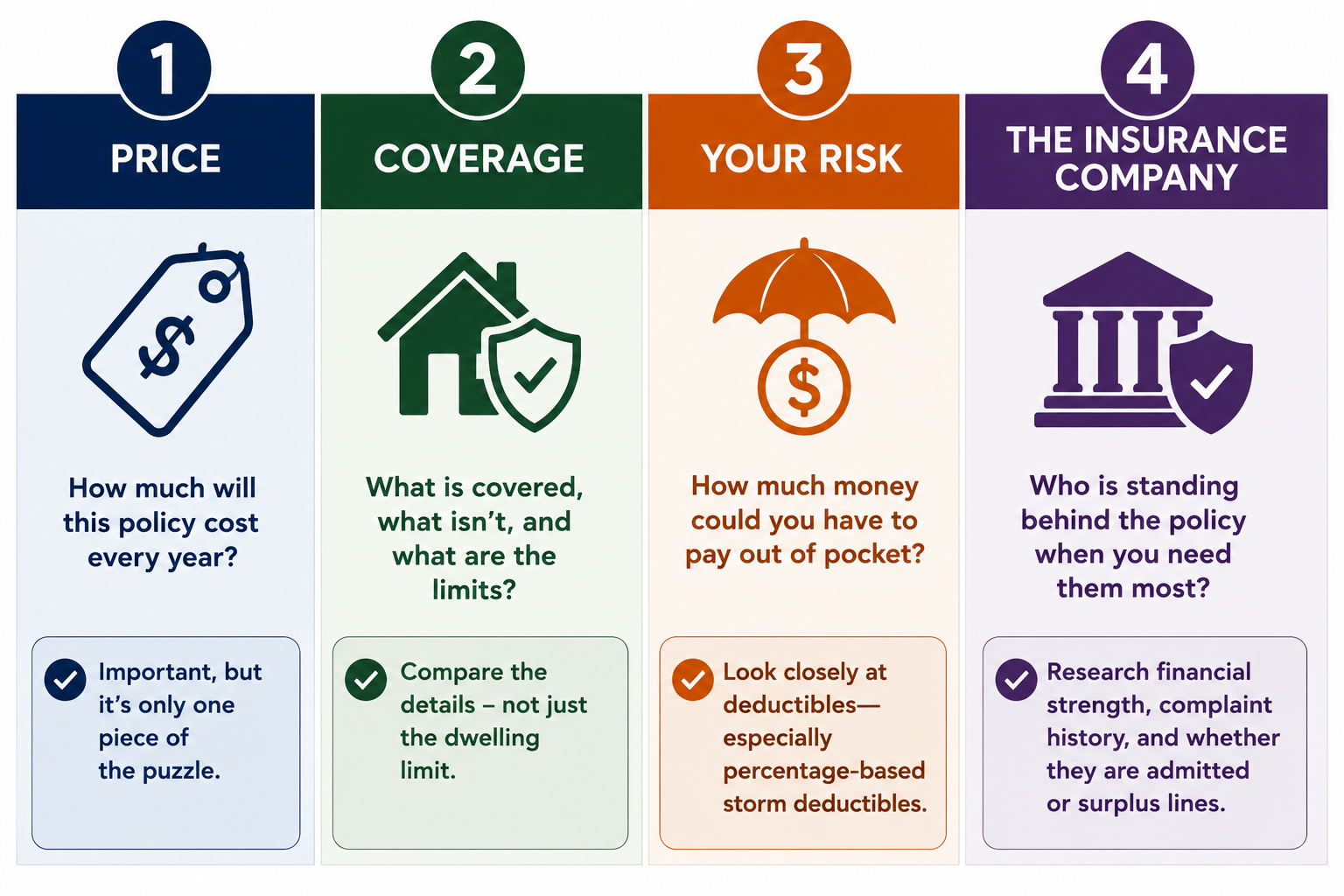
Think of Insurance as Four Things — Not One
When comparing homeowners insurance, I would look at four categories:
1. PRICE
How much will this policy cost every year?
2. COVERAGE
What exactly is covered?
What isn't?
What are the limits?
3. YOUR RISK
How much money could you potentially have to pay out of pocket?
That means looking closely at deductibles — particularly percentage-based storm deductibles.
4. THE INSURANCE COMPANY
Who is actually standing behind the policy?
What is its financial-strength rating?
What does its complaint history look like?
Is it admitted or surplus lines?
You're not simply buying a premium.
You're buying a company's promise to be there when something goes wrong.
Re-Shop Your Insurance After You Buy the Home
Insurance shouldn't necessarily be a "set it and forget it" expense.
Consider shopping your coverage again periodically, particularly if:
Your premium increases substantially
You replace your roof
You install hurricane protection
You renovate the house
Your replacement-cost estimate changes
Your deductible changes
Your insurer changes your coverage
Your carrier's financial rating changes significantly
Your insurance company announces major underwriting changes
Your financial situation changes
The company that offered the best combination of coverage and price five years ago may not be the best option today.
The Bottom Line
When you're buying a home in the South Carolina Lowcountry, insurance should be part of your due diligence — not an afterthought a few days before closing.
Get multiple quotes.
But don't just ask:
"Who is cheapest?"
Ask:
"What am I actually getting for my money — and who is standing behind it?"
Compare the dwelling coverage.
Compare the rebuild estimates.
Compare replacement cost versus actual cash value.
Compare your standard deductible.
Calculate percentage deductibles in actual dollars.
Determine whether wind and hail are included.
Check the insurance carrier's financial-strength rating.
Research its complaint history.
Find out whether you're dealing with an admitted or surplus-lines insurer.
Check your flood zone.
Consider flood insurance even if your lender doesn't require it.
Compare NFIP and private flood options when available.
Ask about hurricane-mitigation discounts.
And make sure you're comfortable with how much money you could realistically have to pay out of pocket following a major loss.
Saving $600 or $800 a year can look great at the closing table.
It may look considerably less impressive after a hurricane if you discover your deductible is $25,000, your roof isn't covered the way you thought it was, your rebuild limit is inadequate or the insurance company behind the policy isn't what you expected.
Shop the coverage. Shop the company. Shop the risk. Then shop the price.
Helpful Resources
The South Carolina Department of Insurance provides information about homeowners insurance, coastal insurance, insurance-company research and consumer complaints.
The National Association of Insurance Commissioners (NAIC) provides its Consumer Insurance Search for researching company licensing, complaints and financial information.
FEMA / FloodSmart provides information about flood zones, flood risk and the National Flood Insurance Program.
Financial-strength information may also be available from organizations such as AM Best and Demotech.
Disclaimer: I am a real estate broker, not a licensed insurance agent. This article is intended for general educational purposes and should not be considered insurance, legal or financial advice. Insurance policies, underwriting requirements, deductibles, coverage, carrier eligibility and flood requirements vary by property, insurer and lender. Buyers and homeowners should consult a licensed insurance professional and their mortgage lender regarding their specific property and coverage needs.
Check out this article next